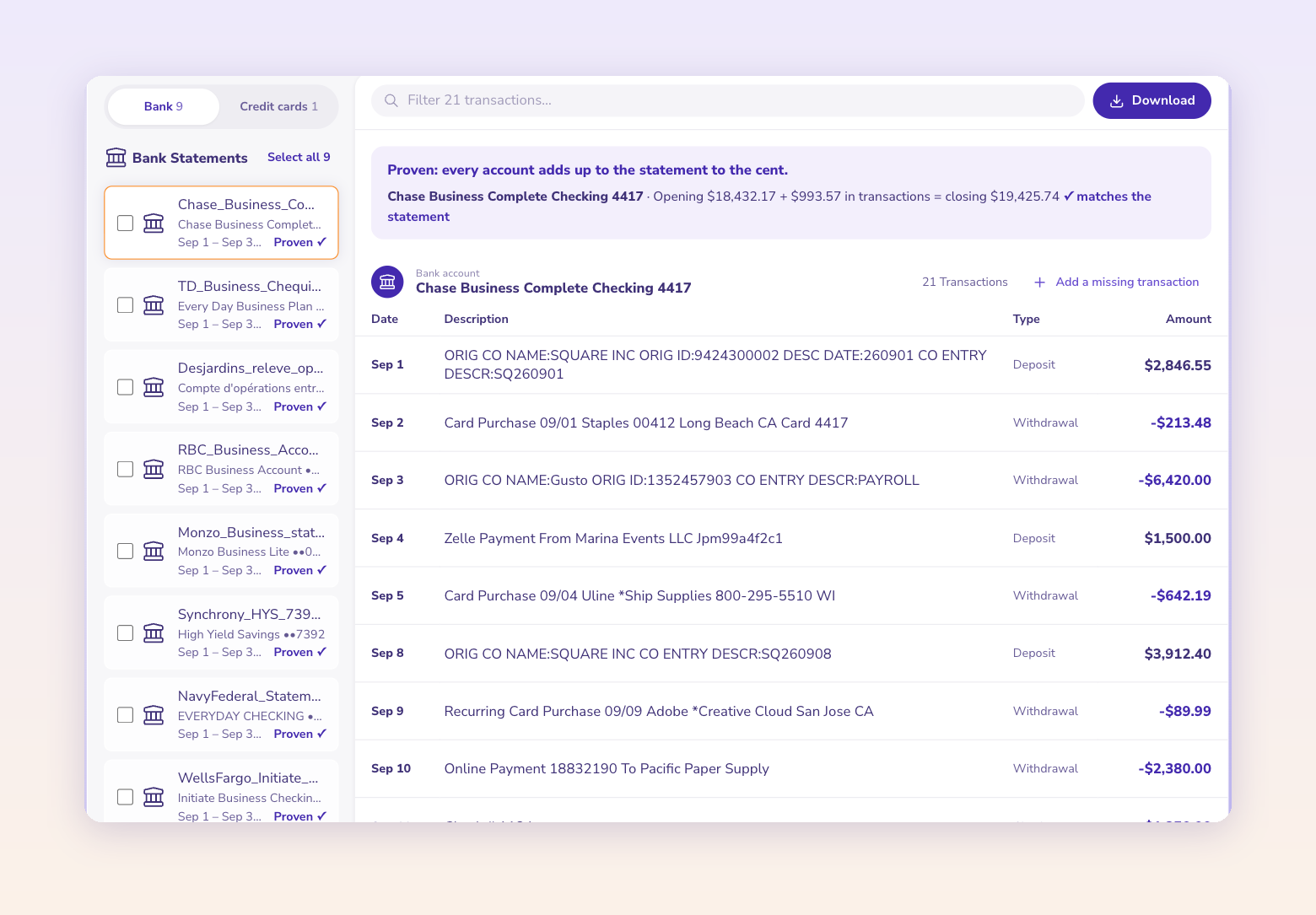
Bank statement analysis turns months of statement rows into the figures a lender, court or auditor asks for: deposits after taking out transfers between your own accounts, withdrawals, month-end, lowest and average daily balances, NSF and overdraft items, large deposits and the payers who come back every month. This repo has a summary template, a fictional three-month sample, and a script that builds the summary from converted statement rows and checks each month against the printed balances first.
| File | What it is |
|---|---|
analysis-summary-template.csv |
The summary layout, one row per month plus a total. Fill it by hand or let the script write it. |
converted-statements-jul-sep-2026.csv |
A fictional landscaping company's checking account, July to September 2026, one row per transaction. Columns: Account, Date, Description, Type, Amount, Own transfer. |
statement-balances.csv |
The opening and closing balance printed on each month's statement. |
analyze_statements.py |
Checks the rows against the printed balances, then prints the monthly summary, own-account transfers, untagged transfers, large deposits and repeat payers. |
summary-jul-sep-2026.csv |
What the script writes for the sample. |
The script is Python 3, standard library only.
-
Download every statement the reader asked for as PDF, for every account. The PDF carries the printed opening and closing balance that proves no page or month is missing.
-
Convert the statements to rows in the shape of
converted-statements-jul-sep-2026.csv, and put each month's printed opening and closing instatement-balances.csv. -
Tag transfers between the same owner's accounts with
Yesin the Own transfer column. Convert the other account's statements too, so each transfer can be matched to its other side. -
Run:
python3 analyze_statements.py converted-statements-jul-sep-2026.csv statement-balances.csv summary.csvIf a month's rows don't reach the printed closing balance, the script says so. Fix that before anyone relies on the summary.
Lowest and average daily balances are worked out from the rows and the opening balance, using each day's end-of-day balance. If the statement has a daily balance section, check them against it.
Fernhill Landscaping is a fictional company applying for an equipment loan with its July to September 2026 checking statements. July opens at 8,530.00.
| Month | All deposits | Own-account transfers in | Business deposits | Withdrawals | Closing balance | NSF or overdraft items |
|---|---|---|---|---|---|---|
| July | 48,300.00 | 5,000.00 | 43,300.00 | 46,950.00 | 9,880.00 | 0 |
| August | 41,750.00 | 0.00 | 41,750.00 | 47,210.00 | 4,420.00 | 2 |
| September | 52,600.00 | 8,000.00 | 44,600.00 | 50,135.40 | 6,884.60 | 1 |
| Three months | 142,650.00 | 13,000.00 | 129,650.00 | 144,295.40 | 3 |
Average monthly business deposits are 43,216.67. Each closing follows from the one before: 8,530.00 + 48,300.00 - 46,950.00 = 9,880.00, then 4,420.00 and 6,884.60, matching the printed statements.
What the script also finds:
- The 13,000.00 moved from savings would overstate deposits by 10.0% if it were counted as income.
- August has a returned check (NSF fee on August 10) and an overdraft fee on August 21. September has one overdraft fee on September 9. The lowest daily balances were -2,510.00 in August and -1,705.00 in September.
- One large deposit: 14,500.00 from Westbrook School District on September 18, about twice the average business deposit of 7,202.78. A lender will ask for the contract or invoice behind it.
- Cedar Ridge Apartments, Hartley HOA and the card settlements came in every month. That steady repeat income reads very differently from one big job.
The company, payers and figures are fictional.
Money moved from savings to checking is not new income. Counted as a deposit, it makes the business look bigger than it is, and an underwriter will find it anyway by matching it to the savings statement.
An analysis is only as good as its rows. When every month adds up from its printed opening balance to its printed closing balance, nobody can say a page or a transaction was left out.
It depends on the loan or the case. Ask for the list in writing before you download anything, and include every account, not just the main one.
Full guide: Bank statement analysis. Related: ZeraBooks bank statement converter.
The content and data in this repository are licensed under
CC BY 4.0. Free to use and adapt with credit to ZeraBooks.
The code (*.py) is licensed under MIT.
Maintained by ZeraBooks.