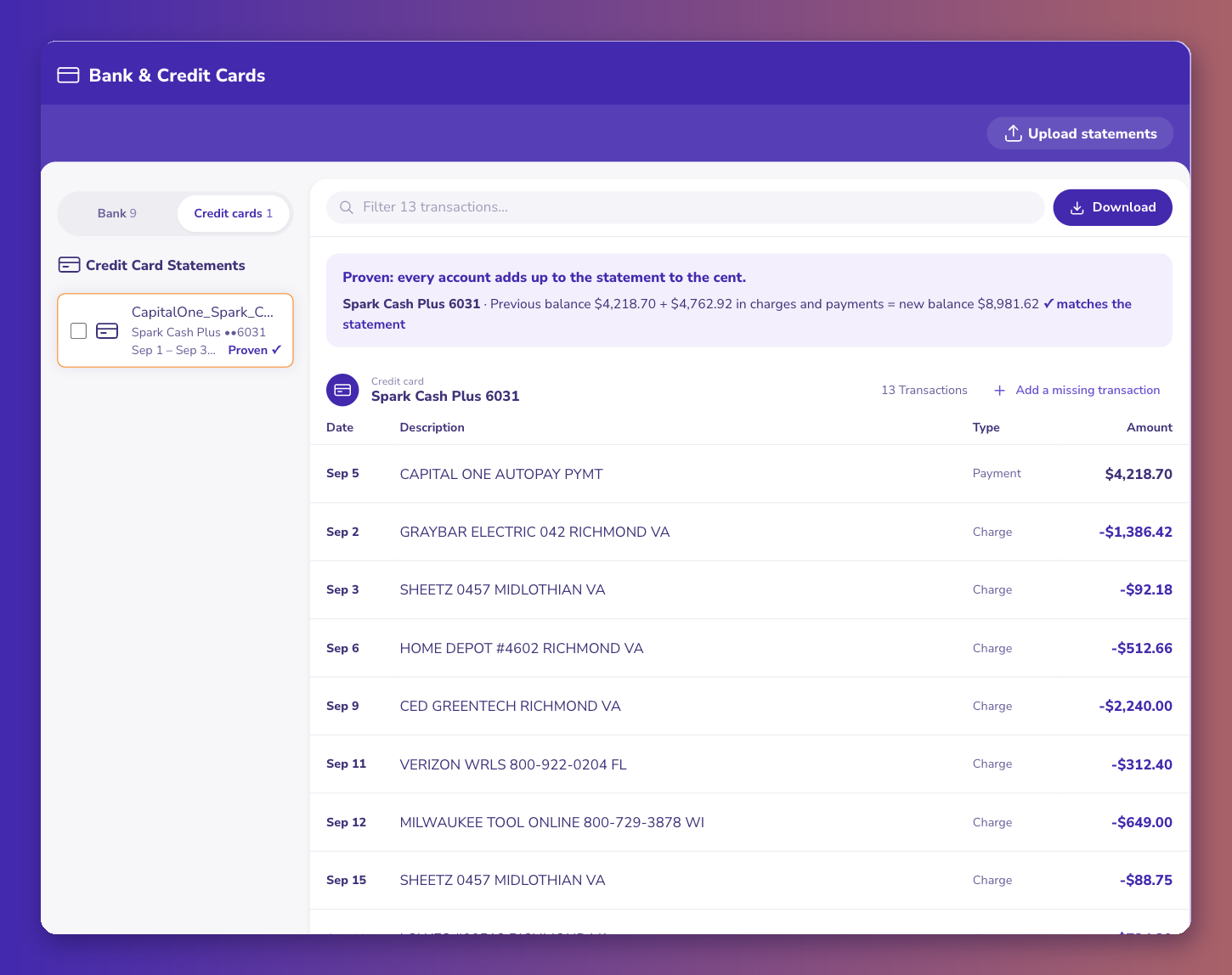
A card statement is proven the other way round from a bank statement: the previous balance plus new charges (fees and interest included), minus payments and credits, must equal the new balance. This dataset gives that formula as Discover, American Express, Capital One and Citi print it, with four fictional statements that tie and the printed lines that aren't transactions. ZeraBooks runs this check on every card statement it converts.
| Issuer | Summary it prints | The proof | Printed but not a transaction | Where the PDF is |
|---|---|---|---|---|
| Discover | Previous balance and each category for the cycle: payments and credits, purchases, balance transfers, cash advances, fees, interest charges | Previous - payments and credits + purchases + balance transfers + cash advances + fees + interest = new balance | Typically a Cashback Bonus block (opening, earned, redeemed, closing) and an Interest Charge Calculation table; Cashback Bonus redeemed as a statement credit IS a row | Part of Capital One since May 18, 2025; accounts move to Capital One's website and app in 2026 and early 2027, and statements move with them |
| American Express | Previous Balance, Payments/Credits (printed with a minus), New Charges, New Cash Advances, Fees, Interest Charged, New Balance | Previous - Payments/Credits + New Charges + New Cash Advances + Fees + Interest = New Balance; each card member's rows add to that member's printed total | Foreign Spend amounts and travel detail (Ticket Number, Date of Departure) under a charge; per-member totals | Statements & Activity at americanexpress.com; the billing period rarely starts on the 1st; employee cards print on the main statement |
| Capital One | Capital One's own guide names Payment information, Account summary, Rewards summary, Transactions, Year-end summary, Interest charge calculation, Account notifications, and says these are typical | Previous balance + charges - payments and credits = new balance | Rewards summary, Year-end summary (fees and interest so far this year), Interest charge calculation | View statements on the account page; Spark business card statements live on a different page from bank statements |
| Citi | Not documented in this dataset; we haven't read enough Citi card statements to stand behind a layout | Previous balance + charges - payments and credits = new balance | On a Citi relationship (banking) statement, the CREDIT CARDS block is a summary as of the last card statement, not card activity | Store and co-branded cards issued by Citi, such as a Costco card, are Citi accounts with statements on Citi's site |
On a bank statement, deposits raise the balance and withdrawals lower it. On a card, the balance is what you owe, so charges raise it and payments lower it. ZeraBooks keeps the books view in the file: a charge is money out, so it is negative, and a payment is positive. Both views have to agree. In every sample below, the new balance comes out of the issuer's formula, and the file total equals the previous balance minus the new balance.
Each sample is a fictional business. In the converted file, charges are negative and payments and credits positive, so the Amount column adds up to how much the balance went down. That is the second check on every sample. Rows are in sample-statements.csv.
Paid part of the last balance, so interest was charged. Payments 1,500.00, credits 36.25 (Cashback Bonus redeemed as a statement credit), purchases 1,499.12, interest 21.94. The proof: 2,413.08 − 1,500.00 − 36.25 + 1,499.12 + 21.94 = 2,397.89. The file adds to 15.19, which is 2,413.08 − 2,397.89. The Cashback Bonus earned this period moved no money and isn't in the file. Guide: Discover statement to Excel.
Two card members. Ana Brooks: charges 1,064.40, less a 120.00 return, 944.40. Theo Grant: charges 1,370.96. New Charges 2,435.36. The proof: 3,105.62 − 3,105.62 − 120.00 + 2,435.36 = 2,315.36. The travel detail under the United charge and the foreign spend line under the Lisbon charge carry no dollar amount of their own. Guide: American Express statement to Excel.
A 5,000.00 payment left part of the balance unpaid, so 46.71 interest was charged on top of 4,539.78 in charges. The proof: 5,602.33 − 5,000.00 + 4,539.78 + 46.71 = 5,188.82. The Year-end summary on the same statement lists fees and interest so far this year; it repeats amounts already counted and stays out of the file. Guide: Capital One statement to Excel.
A co-branded Citi card, paid in full last month, with a 58.00 return this month. The proof: 980.45 − 980.45 − 58.00 + 2,055.85 = 1,997.85. If the deli also banks with Citi, the CREDIT CARDS block on its banking statement shows this card as a summary; convert this card statement, not that block. Guide: Citi bank statement to Excel.
When a card statement prints a total for each card member, ZeraBooks Convert assigns every charge to its card member and checks each member's rows against that printed total, as well as the statement as a whole. In the Amex sample, Ana Brooks has 1,064.40 in charges and a 120.00 return, so her rows net to 944.40, and Theo Grant's rows add to 1,370.96. The download can be split one file per card member. See credit card statement to Excel.
Previous balance, minus payments and credits, plus purchases, cash advances, balance transfers, fees and interest, equals the new balance. Discover and American Express print each of these on the account summary.
Only when it is redeemed as a statement credit, which lowers what you owe and is listed with payments and credits. Cashback Bonus earned or carried over moved no money and is left out.
No. The foreign spend line under a charge shows the amount in the other currency. The dollar charge above it is the transaction.
No. Citi says that block is summary information as of your last credit card statement. Convert the card statement itself.
Discover became part of Capital One on May 18, 2025. Capital One says card accounts move to its website and app in 2026 and early 2027. Once yours has moved, download statements from Capital One.
Yes. ZeraBooks Convert reads Discover, Amex, Capital One and Citi card PDFs and proves each one on its previous and new balance, and each card member against a printed total, before you download Excel or CSV. Pricing is $79 a month billed annually or $149 monthly for 1,000 pages a month, with a 7-day trial.