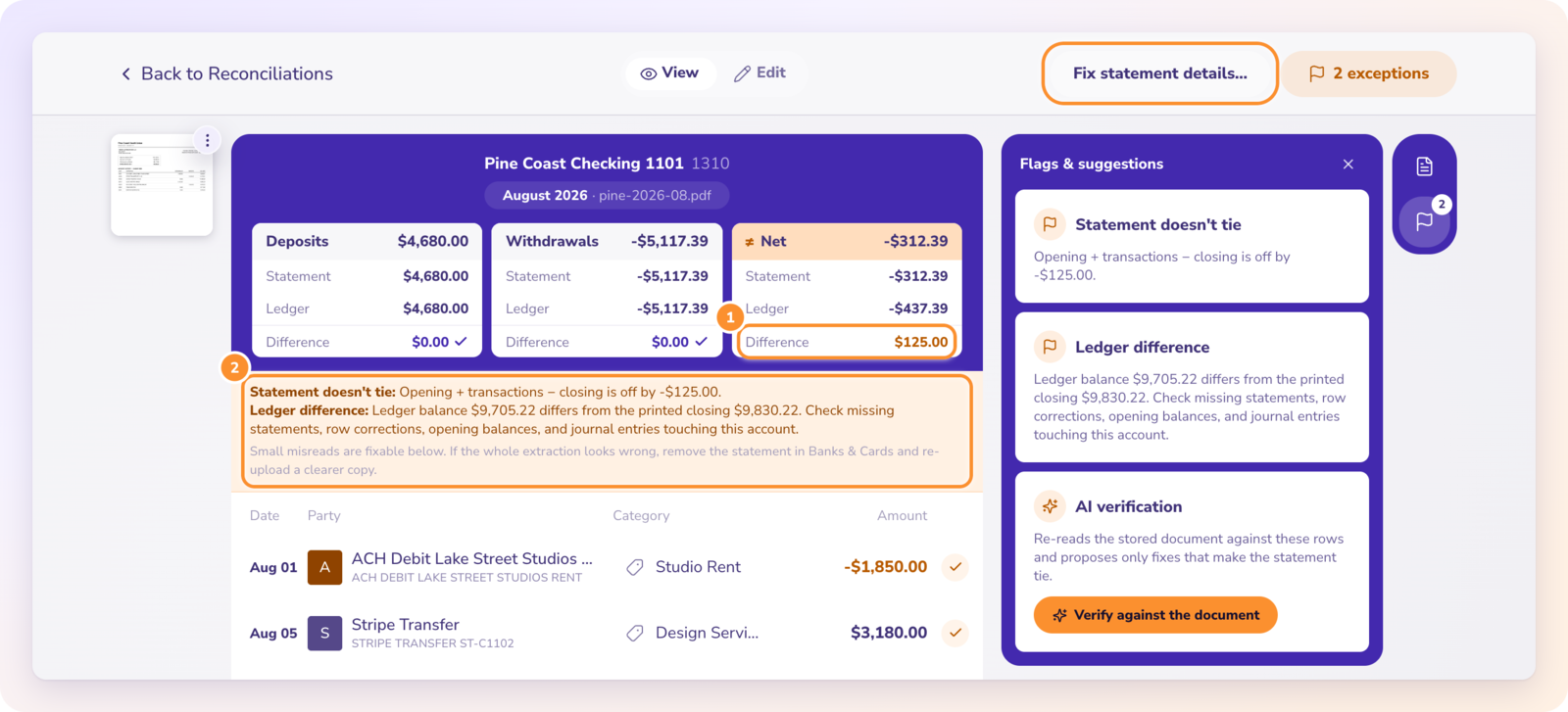
Catch-up bookkeeping fills in months that were never recorded. You start from the last month whose closing balance you trust, gather every bank and card statement since then, and work the months oldest first, reconciling each one before the next. This repo has a month-by-month tracker for every account, a script that lists missing statement months and months that don't tie, and a catch-up checklist, with a fictional business nine months behind.
| File | What it is |
|---|---|
catch-up-tracker-template.csv |
A blank tracker. One row per account per month: statement received, printed opening and closing, imported, reconciled, books closing, notes. |
catch-up-tracker.csv |
The fictional example below, two days into its catch-up. |
catch_up_status.py |
Reads the tracker and lists missing statements, breaks in the balance chain, months that don't tie, and the next month to work on for each account. |
catch-up-checklist.md |
The order of work, what to gather, and when the catch-up is done. |
The script is Python 3, standard library only.
-
For each account, put the last month you trust as its first row, with its closing balance.
-
Add a row for every month since then as statements come in. Copy the opening and closing balances printed on the statement.
-
As you record and reconcile each month, mark Imported and Reconciled and fill in the closing balance your books show.
-
Run:
python3 catch_up_status.py catch-up-tracker.csvAdd a month (for example
2026-09) to say how far the catch-up should go. Without it, the script uses the latest month in the file. -
Work the "Next" line for each account, then run it again.
Halden Bike Repair is a fictional shop with a checking account, a savings account and a Visa card. Its books were last right at December 31, 2025. In October 2026 the owner sent nine months of statements, January to September. Two days in, the tracker shows this for checking:
| Month | Printed opening | Printed closing | Status |
|---|---|---|---|
| December 2025 (last trusted) | 22,418.60 | Starting point | |
| January | 22,418.60 | 19,902.15 | Reconciled |
| February | 19,902.15 | 21,355.40 | Reconciled |
| March | 21,355.40 | 18,770.95 | Books show 18,686.95, 84.00 short |
| April | not sent | not sent | Missing |
| May | 20,114.30 | 23,006.80 | Not started |
| June | 23,006.80 | 21,447.12 | Not started |
| July | 21,447.12 | 24,980.55 | Not started |
| August | 24,980.55 | 22,615.09 | Not started |
| September | 22,615.09 | 25,302.44 | Not started |
What the script reports:
- Checking: April is missing. May opens at 20,114.30, which is 1,343.35 above where March closed, so that is April's net change. March doesn't tie: the books are 84.00 below the statement, the size of one card fee entered twice. Fix March before anything else.
- Savings: every statement is in and January to March are reconciled. Next is April.
- Visa: July isn't in the file at all. August opens at 2,904.66 against June's 3,377.51, so July's net change is -472.85. January and February are reconciled; next is March.
In all, 27 account-months need to be caught up, 7 are reconciled and 20 are to go. Both missing statements were requested from the bank the same day.
The business and figures are fictional.
At the most recent month whose closing balance in the books matches the bank. If no month ties, the job is a cleanup, not a catch-up, because months that were done wrong have to be fixed before new ones are added on top.
Not to start. Bank and card statements carry every transaction and the balances that prove each month. Receipts and invoices answer category questions, and the questions list tells you which ones matter.
For 2026, individual estimated tax is due April 15, June 15 and September 15, 2026 and January 15, 2027. Form 1099-NEC is due to contractors and the IRS by January 31. Both need current books, and so does any lender or landlord asking for a recent profit and loss.
Full guide: Catch-up bookkeeping. Related: ZeraBooks. Catch-up of past months is included: you upload the statements and ZeraBooks does them.
The content and data in this repository are licensed under
CC BY 4.0. Free to use and adapt with credit to ZeraBooks.
The code (*.py) is licensed under MIT.
Maintained by ZeraBooks.