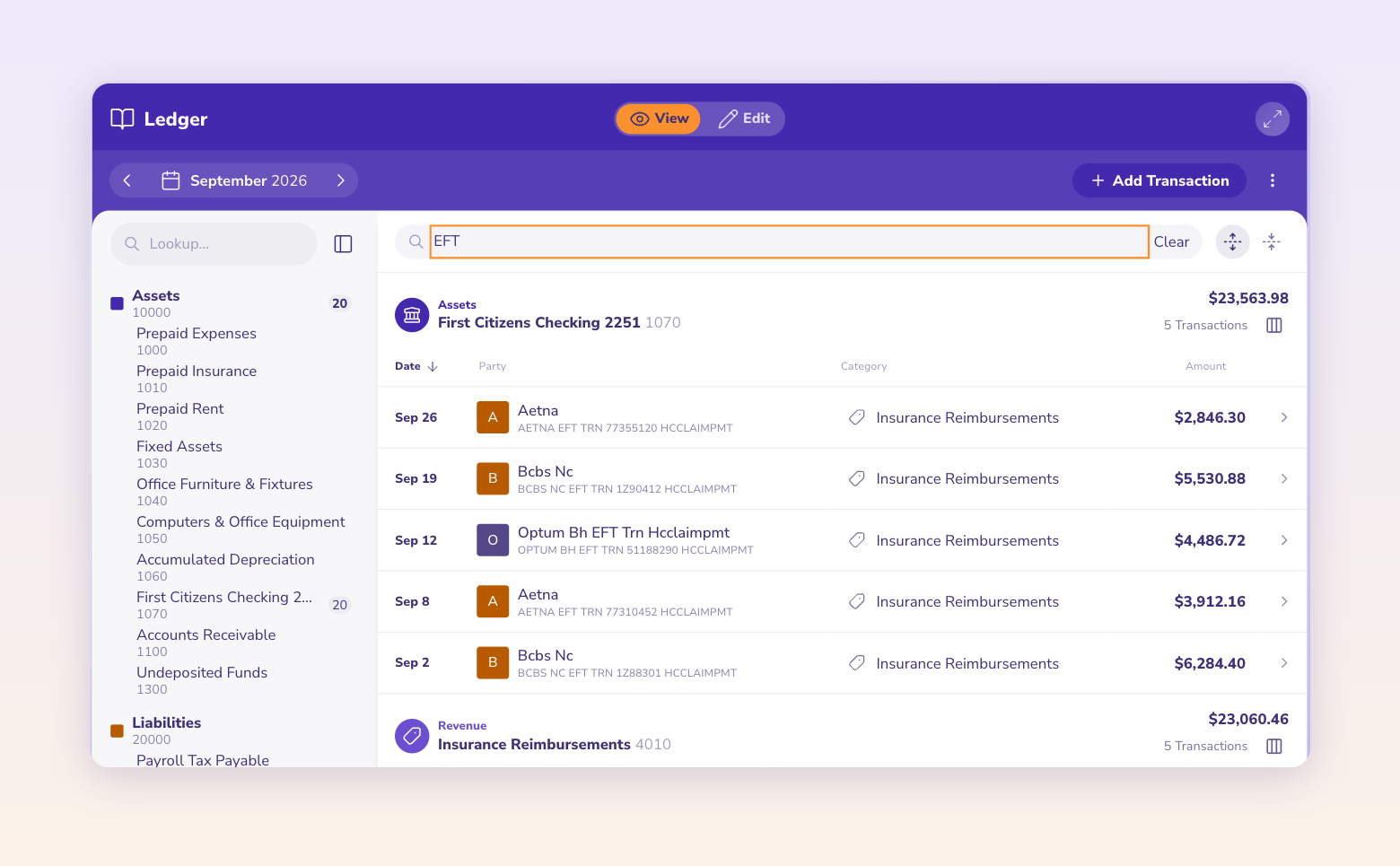
Bookkeeping for a therapy practice records insurance payments and self-pay sessions separately, grosses card payments back up before processor fees, books late-cancellation fees as revenue, pays contract clinicians their agreed share of what they collect, and keeps owner pay out of expenses. This kit has the chart of accounts, a checklist and a worked month.
| File | What it is |
|---|---|
chart-of-accounts.csv |
A starting chart of accounts for a solo or group practice: insurance, self-pay and cancellation fees as separate income, contract clinician payments, supervision and practice costs. Columns: Number, Name, Type, Detail, Notes. |
month-end-checklist.md |
Eight steps for closing a practice's month. No clinical records needed. |
insurance-remittances.csv |
A fictional month of insurance EFTs, each matched to its remittance total. |
clinician-collections.csv |
The same month's collections by clinician, split into insurance, self-pay sessions and late-cancel fees, with each contract clinician's split rate. |
october-2026-month.csv |
The fictional practice's October 2026 on cash basis: every line, its account, and whether it counts in profit. |
check_practice_month.py |
Ties EFTs to remittances and to collections, works out each contract clinician's pay, and prints profit before owner pay. Python 3, standard library only. |
-
Import
chart-of-accounts.csvinto your accounting software, or compare it with the accounts you have. A solo practice can delete the clinician lines. -
Each month, fill in copies of
insurance-remittances.csvfrom your remittance advice andclinician-collections.csvfrom the practice software's payments report. -
Run the check:
python3 check_practice_month.py insurance-remittances.csv clinician-collections.csv october-2026-month.csv -
Work through
month-end-checklist.mdbefore you lock the month.
Harborlight Counseling is a fictional practice: the owner and two contract clinicians paid 60% of what they collect. October 2026, cash basis:
| Amount | |
|---|---|
| Insurance EFTs, 4 payers | 9,860.00 |
| Self-pay card payments for sessions | 5,940.00 |
| Late-cancellation fees | 300.00 |
| Revenue | 16,100.00 |
| Card processor fees, 2.9% of 6,240.00 | 180.96 |
| Contract clinicians, 60% of the 7,400.00 they collected | 4,440.00 |
| Practice management and telehealth software | 149.00 |
| Office rent | 1,600.00 |
| Liability insurance | 62.00 |
| Continuing education course | 295.00 |
| Expenses | 6,726.96 |
| Profit before owner pay | 9,373.04 |
The clinicians' 4,440.00 is worked out from their collections that month, which is why the books need payments by clinician, not just a total. What the owner takes home comes out of the 9,373.04 as a draw or salary, depending on how the practice is set up.
All figures are fictional.
No. An out-of-network client pays you in full and sends the superbill to their insurer. Any reimbursement goes to the client, so nothing more is owed to the practice.
In a split arrangement, usually on what they collected. A session that was billed but not paid yet isn't in the split until the money arrives. Whether a clinician is a contractor or an employee depends on how the work is actually arranged, and your accountant should decide it.
It works while the practice is small and you reconcile to the bank every month. A second payer panel or a clinician on a split is usually when it gets hard to keep straight.
Full guide: Bookkeeping for therapists. Related: ZeraBooks. Catch-up of past months is included: you upload the statements and ZeraBooks does them.
The content and data in this repository are licensed under
CC BY 4.0. Free to use and adapt with credit to ZeraBooks.
The code (*.py) is licensed under MIT.
Maintained by ZeraBooks.